
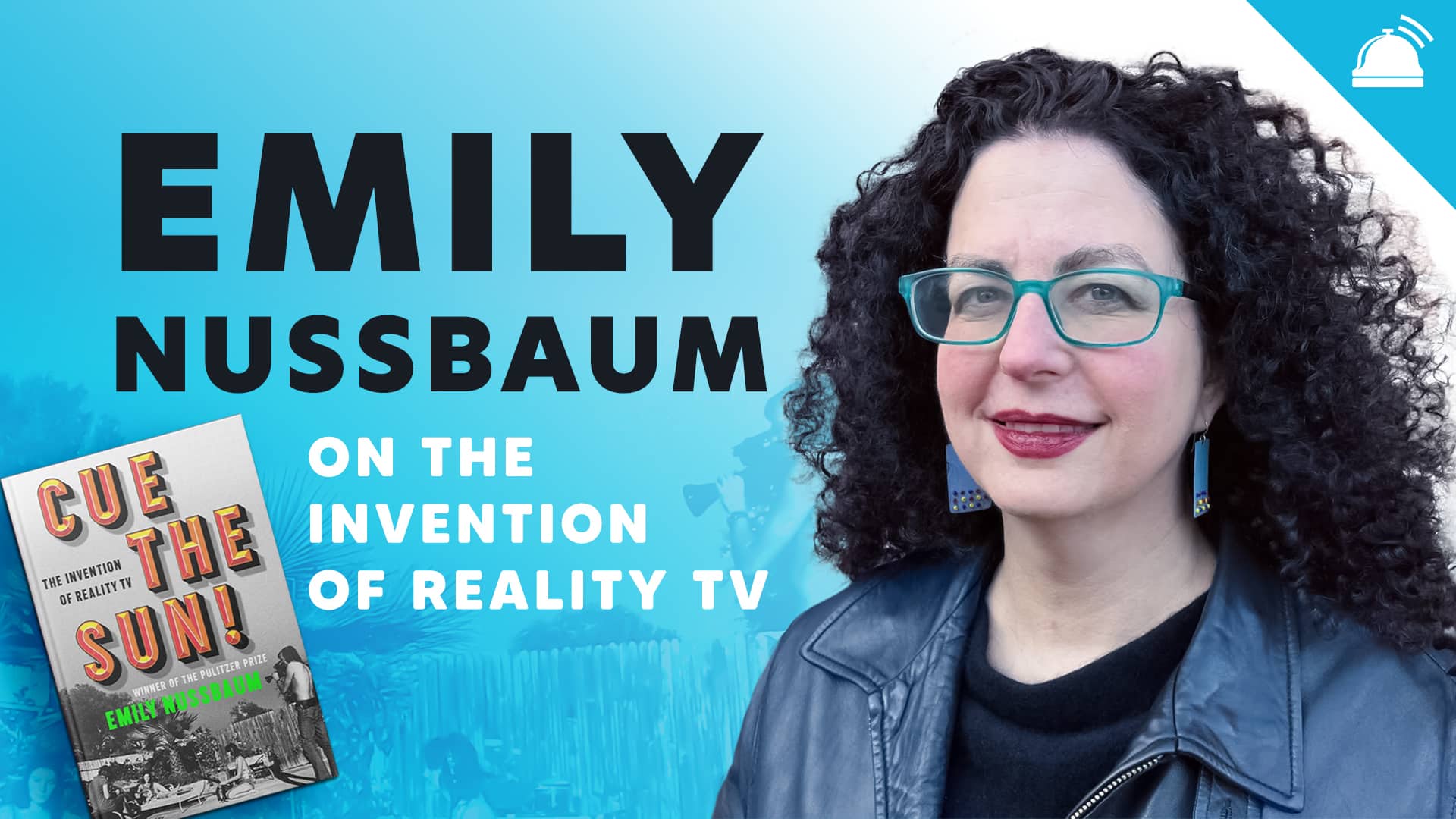
 Rob Cesternino (@RobCesternino) welcomes author Emily Nussbaum onto RHAP to discuss her book, Cue the Sun! The Invention of Reality TV.
[00:00:00] Hey everybody, what's going on? Rob Cesternino and we've got a great podcast for you here today. I've got an interview coming up with the Pulitzer Prize winning author Emily Nussbaum. She is the author of the brand new book, Cue the Sun, all about the invention of reality TV. Emily is an incredible television critic.
[00:00:27] She won the Pulitzer Prize for criticism in 2016. She's also the author of the book I Like to Watch, Arguing My Way Through the TV Revolution. She's currently a staff writer at The New Yorker as well.
[00:00:43] We're going to talk about her book, which I got to read over the holidays, Cue the Sun. It is a great journey through the history of reality TV going back from the 40s and ultimately the final chapter is about The Apprentice. So there will be some discussion about that.
[00:01:02] So if that is something that maybe you're not interested in, come back and listen to another episode of Rob Has a Podcast. But without further ado, here is my conversation with Emily Nussbaum.
[00:01:16] Hey Emily, how are you? What an honor it is to have you here to talk about everything that I just finished reading in Cue the Sun.
[00:01:26] Thank you for having me. I'm excited to talk to you. Yeah.
[00:01:29] Because you clearly have enormous expertise on the subject.
[00:01:32] Well, this was so fun for me getting to read this because I really feel like everything that you've captured in the book, I kind of feel like was sort of like the backdrop to my entire life.
[00:01:44] I mean, I feel like as a young person growing up watching the real world and then getting, you know, to be a fan of these shows and then like going to the chocolate factory ultimately and going to be a part of it.
[00:02:01] And then having, you know, all of this other competition reality TV be such a big part of my own story.
[00:02:08] There were so many interesting things in your book. So first off, just congratulations.
[00:02:15] What an achievement to have chronicled what 70, 80 years of the origins of reality TV.
[00:02:23] Yes. The book, the book starts in 1947 on the radio and then it runs through, it was originally going to run through like 2005, 2006, but the end of the book ended up getting pushed out a little bit.
[00:02:34] So I could cover a few things like RuPaul, but it basically is meant to cover.
[00:02:39] It's like a nonfiction storytelling sourced out account of the origins of reality TV.
[00:02:46] Not all of reality TV. It doesn't include modern stuff.
[00:02:49] It's like, where did this genre come through?
[00:02:52] But the one thing I want to say is like when I started it, I didn't think it was going to be covering 70 years.
[00:02:57] I thought like, I think a lot of people think that it was a relatively modern genre and it had started exploding at the turn of the century and went back to maybe the real world.
[00:03:07] You have an anecdote that you tell at the beginning of the book about how that you were talking with friends in 2003 and you were contemplating writing a book of reality TV and they sort of scoffed.
[00:03:19] They said, oh, you know, better write it quick.
[00:03:21] And then you said that basically you tabled the idea for 20 years.
[00:03:26] What made you ultimately go back and decide to write this book that you first thought of in 2003?
[00:03:34] What made me decide to go back to write it was that I was getting a two book contract and my first book was a collection, an anthology of my critical writing for The New Yorker.
[00:03:44] And the publishing company was interested in a in a nonfiction reported book because I do a lot of reported pieces and profiles as well.
[00:03:53] And so literally in one day I wrote two two separate book.
[00:04:00] What is it called when you write a like a book proposal?
[00:04:03] I wrote two quick book proposals and one of them was the reality book proposal.
[00:04:07] I have to say it's quite good given that I wrote it in a day.
[00:04:09] I did.
[00:04:10] I hadn't actually re-researched it since I first talked about it.
[00:04:14] Obviously, I'd been a TV critic for a long time and I had watched reality television.
[00:04:18] But that's why it was such a surprise and sort of gratifying mystery seeking experience once I actually started doing the reporting on it.
[00:04:28] But one thing to clarify, when I had that conversation in 2003, it wasn't even just with two friends.
[00:04:33] It was with my now husband, Clive.
[00:04:36] We were dating and we got together with a friend and we were all journalists.
[00:04:40] And the whole idea was, what is a hot thing that we can write a book about?
[00:04:45] And at the time, I had been obsessively watching Big Brother, as was clearly true with you as well.
[00:04:52] And I had watched Survivor and I was also a big real world person.
[00:04:55] But I had gotten very into the first season of Big Brother, like the failed season.
[00:05:01] And I was watching it online.
[00:05:03] So honestly, when I pitched the book, I feel like what I was trying to do was come up with an excuse for why I was live streaming this flop reality show that everybody hated.
[00:05:13] I was like, oh, I'm just doing research.
[00:05:15] But yes, my friend at the time said, oh, this is just a fad.
[00:05:19] If you try to write a book about this in 2003, by the time you're finished with the book, the whole thing will be done with.
[00:05:25] And so this book was there to prove him wrong.
[00:05:27] Something that I noticed was I feel like that the only times you talked about your own fandom, and I feel like it comes up twice that you mention how, as you did just now, about how you were really fanatical about the first season of the Big Brother live feeds.
[00:05:45] What was it that attracted you to it then?
[00:05:49] And then I'm assuming then at some point you stopped being fanatical about the Big Brother live feeds.
[00:05:55] Yes, I did.
[00:05:56] You know, it's so funny because I know that you were really drawn into Big Brother from the second season.
[00:06:01] And I completely get that.
[00:06:02] I watched the second season, and the second season was fascinating.
[00:06:05] But, you know, this book isn't a book of my own response.
[00:06:10] The reason that stuff isn't in there that much is that this book isn't a critical book about my own thoughts about various shows and reality TV.
[00:06:17] I mean, I've written a few reviews on shows.
[00:06:19] I actually wrote a column for The New Yorker about Big Brother, like a late season of Big Brother.
[00:06:23] And I wrote, I think, a pretty good column about Vanderpump Rules.
[00:06:28] But most of the time when I've been writing critical writing, it was about scripted shows.
[00:06:32] So I actually hadn't had an opportunity to revisit this.
[00:06:35] And maybe I should write about that.
[00:06:37] But what drew me to it?
[00:06:39] I was a freelance writer who was procrastinating.
[00:06:41] And also, I was, for not a young person, a pretty online digital early adopter.
[00:06:49] And I was fascinated by the rise of online streaming, which seemed to me to have a lot of potential and be very dangerous.
[00:06:57] So I immediately signed up for it.
[00:06:59] But I think I had read an article in The Times or something about Endemol doing Big Brother in the United States.
[00:07:06] So I knew something about the earlier seasons of Big Brother.
[00:07:09] But honestly, I was just watching it because it was impossible to look away from.
[00:07:14] And I realized that I'm one of the only seven people in the country who felt that way about the first season.
[00:07:18] But I would just put it in the corner of my screen and watch the characters wake up in California.
[00:07:24] And I felt embarrassed about this.
[00:07:25] But I was very compelled, not so much by the show than by the live feeds, which were this weird documentary experimentation.
[00:07:34] I don't have a really good explanation for why I was watching it or some highfalutin justification for it or defense or critique or whatever.
[00:07:43] It was literally like I was emotionally very drawn to it.
[00:07:46] And also, it made me uncomfortable.
[00:07:48] And a lot of what I write about in the book is that the reaction of the audience to these reality shows, which is a mixture of fandom, obsession, disapproval, moral outrage, disgust, anxiety and shame, like this very powerful ball of emotions, is part of what has always driven reality television and reality experimentation on back to radio.
[00:08:13] So the book's title, Cue the Sun, it comes from The Truman Show.
[00:08:18] And you discussed the scene in The Truman Show where the line ends up being said by the Ed Harris character.
[00:08:27] How did you arrive at that being the title for the book?
[00:08:32] Well, I think this is true with a lot of people writing books.
[00:08:34] You just try many different titles.
[00:08:36] I love The Truman Show.
[00:08:37] Like, I really do think that that is an absolutely brilliant movie.
[00:08:40] It's also a big popular movie and it's familiar to people.
[00:08:44] So I thought – I rewatched the movie looking for something to pull from.
[00:08:50] But the reason that that title, as opposed to various terrible titles, I consider, ended up working is that a lot of the book – the book's about the creation of the reality genre.
[00:09:01] But it's also about the invention of the workplace and about the relationship between cast and crew.
[00:09:06] And it's so central to the book is the innovation and often very upsetting aspects of this complicated, mutually manipulative relationship between producers and cast members.
[00:09:19] That scene is the scene that's like at the heart of the relationship between Truman and Christoph where he's trying to run away.
[00:09:27] He's trying to get off The Truman Show and literally sail for the horizon and flee in the darkness.
[00:09:34] And then Christoph says, cue the son.
[00:09:36] And the whole thing is a big stage set and they're trying to chase him down.
[00:09:40] So I felt like that was a good thing about that title was that it captured that tension and anxiety about that relationship, which is really different than almost any kind of art making, right?
[00:09:50] Like, you make a scripted show.
[00:09:52] That's not the dynamic.
[00:09:53] Like, there's this – the thing I always say about reality television – and obviously there are many different kinds of shows, so it doesn't apply the same way to each show.
[00:10:00] But that it's about a relationship between cast and crew.
[00:10:06] And the thing that people see on screen is the residue of that relationship.
[00:10:10] They just see the behavior of the cast members.
[00:10:13] They don't see the questions that were being asked by the crew members.
[00:10:15] They don't see what the editors did.
[00:10:17] What they see is, like, the leftover element of that.
[00:10:21] And that's something that you obviously know about because you've had that experience in person.
[00:10:24] So part of what was very powerful to me in interviewing people for this book – and I interviewed more than 300 people.
[00:10:31] Both lots of cast and crew, all sorts of different positions – was finding out from their perspective, like, what their story was of those relationships.
[00:10:39] Yeah, I'd love to ask you about the interviews that you did for this book because, one, I don't even know how you would start a process such as this.
[00:10:48] And then also, you know, how do you go about finding and tracking down all these people for the interviews?
[00:10:53] So I guess let me start with, like, where did you start?
[00:10:57] Did you go chronologically or did you go through sort of like, okay, these are the ten pole shows I know and then work in a non-chronological order?
[00:11:04] Well, honestly, it was a big mess, like I think is true for a lot of people writing nonfiction books.
[00:11:10] You start out with this huge mess and you're kind of reaching around trying to find things.
[00:11:15] The most major thing was that the internet is just an absolute godsend for this.
[00:11:19] Because initially, honestly, when I got – when I started doing the book, I just went on Twitter, which at the time I was using and I'm not using anymore,
[00:11:27] and said I'm writing a book on reality television.
[00:11:29] And I immediately got a lot of emails from people.
[00:11:31] And the great thing about this, and I always say this, is that everybody's NDAs have expired, right, from those early periods.
[00:11:38] So there were a lot of people with really good stories to tell who immediately wanted to contact me.
[00:11:41] And they did know that I had written about TV.
[00:11:44] And even if I'm critical of reality television in a lot of ways, I wasn't writing some sort of apocalyptic book about how this is all garbage and has ruined the world.
[00:11:53] So I felt like I – right away I got a lot of people writing to me.
[00:11:57] But of course there were people I knew I wanted to speak to.
[00:12:00] So, I mean, I found people all sorts of different ways.
[00:12:04] Like, you know, I wanted to talk to Mike Darnell and Mike Flight.
[00:12:08] So I, you know, obviously contacted them straightforwardly through their representatives and set up interviews with them.
[00:12:14] And I actually did several interviews.
[00:12:16] It shows up in the book right at the beginning in Los Angeles.
[00:12:19] And then the pandemic descended.
[00:12:23] And so every other interview I did after that, I did on Zoom or whatever.
[00:12:28] But there were a lot of people who were reachable because they're online.
[00:12:32] And everyone I talked to, I would ask for a list of other people in their contacts and I would contact them.
[00:12:37] But there were people who were hard to find.
[00:12:39] Like, you're a survivor person.
[00:12:41] So I knew that – you know, like I actually had no trouble reaching Richard, for instance.
[00:12:46] But I only reached Sue at the very end.
[00:12:50] And I really was like, I need to find her because other people talk about her in the book.
[00:12:55] I was like, it's just not fair to tell other people's story about what happened in that first season.
[00:12:59] And especially because people clashed a lot with her and everybody has different versions of these stories.
[00:13:05] And it was important to me that when somebody was, you know, shit-talking somebody else or telling a version of the story that somebody might not agree with, that I reach that person and get their perspective.
[00:13:15] So Sue had sort of dropped off the radar a lot.
[00:13:18] And finally, I tried all these different methods to reach her.
[00:13:22] And then finally, I found like the one profile of her that had been written around 2002 that was at her home.
[00:13:30] So the guy had clearly spent time with her.
[00:13:33] And I looked him up, the writer.
[00:13:35] And then I contacted him.
[00:13:36] And he was great.
[00:13:37] And he literally got me in touch with her the next day.
[00:13:40] So there were people where I tried tracing them various different means.
[00:13:44] The one reporting thing I was very proud of was I have a chapter on Chuck Barris and all his game shows in the 70s and the dating game and the newlywed game and the gong show.
[00:13:54] I actually had written the chapter.
[00:13:56] But I didn't have as many sources for it because a lot of people are older or had died.
[00:14:01] And I was basing it mostly on his fakakta memoirs, which are crazy and filled with, you know, exaggerations and stuff and coverage from the time.
[00:14:12] But I felt like the chapter was missing the voices of the people who worked with him.
[00:14:15] So I set out to find a lot of his producers.
[00:14:18] And they're really old at this point.
[00:14:19] And the one that I was very proud of was I found the names of some of his producers.
[00:14:24] And they'd gotten married on the show.
[00:14:26] They'd met making the show together.
[00:14:27] And then she had a store on Etsy.
[00:14:31] So I was searching and searching online.
[00:14:33] And I found a store with somebody by the same name.
[00:14:35] So I just wrote to her on Etsy at her little shop where she sold cute little crafts.
[00:14:41] And I said, did you used to work for Chuck Barris?
[00:14:43] And then she got me and, you know, I talked to her.
[00:14:45] I talked to her husband.
[00:14:46] And they had some of the best stories.
[00:14:48] So some of the – there's a level at which I could have researched this forever because there are a million really colorful, interesting people who are involved in this and their stories had not been told.
[00:14:58] And you brought up the first season of Survivor.
[00:15:00] And I thought you were going to talk about Colleen Haskell, who I believe you also got to speak with for the book.
[00:15:07] And I was actually very surprised when I was going through it.
[00:15:11] I was like, oh, wait, these are new Colleen Haskell quotes.
[00:15:15] And to my knowledge, I don't believe that she has spoken about Survivor in 20 years.
[00:15:21] I think Colleen and Greg were the two people.
[00:15:24] You know, there's only one person – this was just circumstance, but I didn't talk to Jenna.
[00:15:28] But I talked to everyone else who was a living member of the first cast at Survivor.
[00:15:34] I mean, honestly, I just – I contacted Colleen and I explained what I was doing.
[00:15:41] And I think she'd read some of my stuff, so she was okay with talking to me.
[00:15:45] But it wasn't like – there was a sort of collect-em-all Pokemon quality with some of these shows where you really do want to hear everybody's voice.
[00:15:55] But Colleen was so wonderful to talk to and her perspective was so valuable to this.
[00:16:00] Especially, you know, like everyone came from a different background and a different POV on that show.
[00:16:05] And I was specifically interested that after she was on the show, she had taken several crew jobs in reality television as a way of kind of working out her feelings about it.
[00:16:16] I mean, there were a lot of people like that who talked about their relationship – not just what had happened on the show, but their relationship with the whole thing.
[00:16:24] And yeah, I mean, similarly, it's not like I had to hunt down Greg and Colleen.
[00:16:29] They just – I explained that I was doing a substantive project and for whatever reason, they were both comfortable talking with me.
[00:16:36] And, you know, and I told everybody, you know, I'm interviewing everybody.
[00:16:40] I'm fact-checking everything.
[00:16:41] I want to make sure people are fairly represented, especially because there's a lot of tabloid stuff that goes along with reality fame.
[00:16:50] And, you know, I hired a bunch of New Yorker fact-checkers to try to make sure they didn't misunderstand stuff.
[00:16:55] And also sometimes because people, again, have very different perspectives on what happened.
[00:17:01] But Greg – the conversation with Greg was great because he really has different feelings about his behavior now.
[00:17:07] And also Greg kept coming up when I talked to people about that first season because he was such a trickster on the show and was sort of driving the producers crazy.
[00:17:16] And once I talked to Greg, I really understood his perspective on it, which was to me so recognizable.
[00:17:22] I know – how old are you?
[00:17:24] So I'm 46.
[00:17:25] You're 46.
[00:17:26] I'm 58.
[00:17:27] So it was like – to me, Greg's was like a pure Gen X attitude toward reality TV.
[00:17:32] It's the same thing that haunted the real world in a lot of ways that first season is this anxiety of selling out, of doing something cheesy, of doing something unethical.
[00:17:43] But, you know, and he just – I don't know.
[00:17:46] And obviously he was a huge nature guy and he was very eager to be on the island, but he was not into the game show part of it, which is exactly why you went on the show.
[00:17:57] There were other people who felt very differently.
[00:17:59] Yeah.
[00:17:59] Like you were a game show fan.
[00:18:00] I loved game shows.
[00:18:02] I loved watching people like Will Kirby, who you spoke to in the book, and Rob Mariano, who were big influences on me.
[00:18:12] And I was like, oh, okay.
[00:18:13] I get it.
[00:18:14] Like this is like – you can be – you know, you can have this relationship with the audience like on the show.
[00:18:20] And those were things that were just like not on the mind of those people who were, you know, those first, you know, pioneers of coming through Survivor.
[00:18:29] You brought up Greg as being sort of like the epitome of the Gen X attitude and those, you know, early real world casts.
[00:18:38] One of the things I thought that was really interesting was – and I think that maybe this came from – I'm not sure if it was from Mike Fleiss, but this idea of why would I go on a show and kiss somebody is like the generation that like started this thing.
[00:18:56] But the generation now are the people who, you know, grew up with this and have this –
[00:19:02] Yeah, why would I kiss somebody if there wasn't a camera around?
[00:19:05] Yeah, why would I do this if there wasn't a camera?
[00:19:08] I just think that that's such an interesting part of like where this all has gone, where that the first people to do this, that there was like a reluctance to being a part of this.
[00:19:19] And now it's such an appeal to go and be a participant in these shows.
[00:19:25] I mean, I think there's been an enormous cultural shift in terms of being out in public.
[00:19:30] Obviously, the internet and social networking changed a lot of this.
[00:19:33] The period that I'm tracing, not only was there a radical innocence to a lot of the people going on these shows for a surprising length of time because even once the shows were on the air, a lot of the formats were genuinely new and people really didn't expect what they got or expect how they were made.
[00:19:50] Although I have to say I've come to the conclusion that people going on shows are still incredibly – and, you know, to me sympathetically naive because nobody can fully expect what will happen.
[00:20:03] Or fully understand the making of the show or how things can be misrepresented or how they'll feel emotionally.
[00:20:09] But the period that I trace in the book is a more heightened kind of innocence.
[00:20:13] There's this repeated motif in the book where people kept telling me, well, mine was the only true season of reality TV because nobody knew what they were getting into.
[00:20:22] And this happens over and over again throughout the book.
[00:20:25] You know, I've swayed back and forth on how I feel about that shift that you're talking about.
[00:20:30] I mean, on the one hand – I say this thing in the book at one point where I say the faker a show is, the more ethical it is, which is there's a sort of dark truth to the fact that shows that are actually quite phony and involve more soft scripting are essentially a kind of collaboration between producers and cast members where they're just improvising drama and scenes.
[00:20:50] I'm especially talking about it on like soap opera-like shows.
[00:20:52] So you're not tricking people into acting authentically and exposing them to all sorts of interpersonal vulnerability.
[00:21:00] You're just play acting.
[00:21:02] It's a little bit different.
[00:21:03] So it's faker, but people are less put under pressure and fooled.
[00:21:08] But I also think that during the period I was writing about the aftermath of becoming a reality star was pretty terrible because you were globally famous, but you had no career.
[00:21:20] And you did not have any prestige because people looked down on reality television, nor did you have the infrastructure to protect yourself from the bad parts of fame like the notoriety or crazy haters or all that kind of thing.
[00:21:33] Now there actually is some kind of online world in which you could make money.
[00:21:38] And you yourself went through this whole transition where you went on the show in part because of the fame aspect as well as your fascination with the gameplay.
[00:21:46] But there were so many people from that period when you went on who I feel just got like blasted out of a cannon and then ended up staying in LA and just trying to figure out the economy of it all.
[00:21:58] I mean, it's pretty complicated.
[00:21:59] And so there's a lot of stories of people being really wounded and traumatized, but it's not universal.
[00:22:07] And anyway, the one small thing I wanted to say is I wrote a piece about Love is Blind that came out like a year, year ago, a year and a half ago.
[00:22:15] And I have to say my sense that people going on current reality shows were surely more savvy about what was going to happen.
[00:22:25] It was kind of lowered by that experience of reporting that story because I realized on a lot of shows, people are deliberately casting people who don't know anything about reality television because you can get more authentic behavior out of them and they'll sign contracts and not think about them.
[00:22:40] And so this isn't in the book because I talk a lot about labor issues in the book and the attempt to unionize crew members.
[00:22:47] But now there's this attempt to get a little more protection for cast members.
[00:22:51] And I think that's a very important movement because the whole period I trace is a period where nobody had any rights and anybody who was hurt had no recourse.
[00:23:01] And now we're moving toward a new period where there are so many ex-reality stars that you can get some kind of solidarity, mutual education.
[00:23:10] Yeah, I think that's such an interesting discussion.
[00:23:13] And I had been aware of some of the conversations and you brought up Bethany Frankel in the book and some of the labor issues around.
[00:23:20] And it's like two very different issues, labor in terms of the crew and then also labor in terms of the participants on the show.
[00:23:28] But I think it would be so difficult to where you have shows like Survivor, Big Brother, all the competition reality shows where you have people who are coming from nowhere to be a part of the show.
[00:23:41] And if anybody really tried to play hardball in some sort of labor negotiation, they say, OK, well, we'll just find the next person.
[00:23:49] I think that like the much more interesting discussion is the idea of like should there be some kind of like a labor discussion around like the housewives, people that are sort of like recurring cast that are back season after season where that they don't have a show without these specific people.
[00:24:08] It seems like that they have a much better case to be able to have something.
[00:24:11] I think that cast members like the housewives have a better case for unionization in a traditional sense.
[00:24:18] But but I think everybody who appears on reality shows deserves protections on various levels against, you know, they should be properly compensated.
[00:24:27] They should have protections in in terms of abuse and exploitation.
[00:24:31] But the two things I want to say about this is one of them is this is not I mean, the discussion about rights for cast members is new.
[00:24:37] But why does reality television exist?
[00:24:39] It exists. It exists for many reasons.
[00:24:42] It's like a psychological social experiment.
[00:24:44] It's a as I say in the book, it's a mixture of documentary and game show and soap opera and prank shows, all these different kinds of artistic experimentation.
[00:24:54] But the other reason exists is because you don't have to pay writers and actors like that.
[00:24:58] That was true back in radio.
[00:25:00] So the origins of it actually were always as a strike breaker.
[00:25:03] And I think this kind of runs through the history of reality TV.
[00:25:08] It was really only when I was working the Love is Blind piece that I realized that there's a category that cast members for reality shows are in in labor terms, in SAG-AFTRA terms.
[00:25:17] They're kind of a carve out and they qualify as what's called bonafide amateurs, which is essentially, you know, not scripted cast members, but also not non-scripted protected people like talk show hosts and stuff like that.
[00:25:30] But, you know, this is a longer conversation that goes beyond the book.
[00:25:35] But like Bethany has gotten a lot of publicity for that, but it's not as though Bethany Frankel is starting a union, to my knowledge.
[00:25:44] There are different ways that I think different cast members can get rights.
[00:25:47] Some of them are by knocking out those contracts, which have what to me seem like they should be illegal levels of NDAs enforcing people into private arbitration.
[00:25:55] I agree. People who are in multiple cast seasons and are essentially the cast of the show and also are not really on a documentary or on something quasi-scripted clearly should have some kind of proper compensation and all that kind of thing.
[00:26:13] But I actually think, you know, people have suggested all sorts of other ways to make rules.
[00:26:17] Like you could have somebody on set who's there to watch out for the rights of the cast members because you just cannot rely on the producers.
[00:26:25] They have even the most well-meaning producers cannot be trusted to compensate and protect the rights of cast members.
[00:26:34] And a lot of the genre, even if you're a fan, even if you love it, is based on truly shocking levels of manipulation and downright cruelty.
[00:26:46] And those are some of the darker parts of this book.
[00:26:49] But for people who are deep fans of reality television, I think it's better if you know.
[00:26:54] So you actually understand what your favorite genre consists of, like the making of it, the artistry, the history and the psychology and yeah, the morality of it.
[00:27:04] Because these are things are complicated things.
[00:27:07] So the darkest chapter in my book is on The Bachelor.
[00:27:10] And, you know, when I tell people stuff that went on, they are shocked.
[00:27:14] But I'm like, that's why I want the NDAs to go away because I want people to tell their stories.
[00:27:18] Yeah.
[00:27:19] And that's when your podcast people do tell their stories.
[00:27:21] Just some, you know, I'm sure there are limits on what they can say, but still.
[00:27:25] Yeah.
[00:27:25] And I think that the dating shows are really like a class of their own.
[00:27:30] Whereas I feel like, you know, Survivor and Big Brother, I'm sure that there are, you know, many like, you know, horror stories, you know, from like the hundreds and hundreds of people, you know, across the many years of like making the competition shows.
[00:27:44] I think that, you know, it's detailed quite a bit, like just the amount of alcohol that the contestants end up getting plied with to, you know, make them like really buy into this world of this, like, you know, romantic fantasy that they're, you know, being recorded in.
[00:28:04] Yes.
[00:28:05] I mean, that's definitely true in dating shows.
[00:28:07] That's historically true in dating shows.
[00:28:09] I don't know whether that's, I don't know whether there are more rules about it.
[00:28:12] Again, because I only cover, I mean, I really focus on first seasons.
[00:28:15] I focus on like the creation of the formats.
[00:28:17] So the first season, certainly the first season of The Bachelor, but also like Joe Millionaire and, you know, a lot of the other dating shows.
[00:28:26] I talked to a lot of crew members, including producers and directors and especially camera guys who were just the greatest.
[00:28:33] I mean, obviously there are women who do camera work as well, but people I spoke to were guys.
[00:28:38] And they, I would always ask people, what's the kind of show you love to do?
[00:28:44] And what's the line you won't cross?
[00:28:45] And a shocking amount of people said dating shows.
[00:28:48] I thought they would say cruel shows or prank shows or tortury shows, but they all said dating shows.
[00:28:53] And part of it was because working on those shows certainly early on was about watching 22-year-old, very credulous women vomit and get filmed by hidden cameras through the blinds.
[00:29:08] Like, even for very salty and not necessarily particularly feminist guys, that sometimes felt gross.
[00:29:15] But it's also because, you know, even without the alcohol, those shows are about squeezing people until they break down and have our heart broken.
[00:29:25] So some people, you know, I talked to, I'm sure anybody who's really into reality TV should have watched.
[00:29:31] And if you haven't, you should Unreal, which is really one scripted show that's very much about like the making of a reality show.
[00:29:38] And it was created by Sarah Gertrude Shapiro, who was a producer on The Bachelor.
[00:29:43] And I think that show is a really powerful example of some of the worst things that can happen on a reality show.
[00:29:51] So it's a new year.
[00:29:52] You know what that means, setting big goals.
[00:29:55] Maybe you promised yourself you're going to hit the gym every day.
[00:29:57] Or maybe you said you're going to learn to make fire with a flint for once.
[00:30:01] Or the classic, save more money.
[00:30:03] But let's be honest, New Year's resolutions tend to fizzle out by February.
[00:30:07] Wouldn't it be great if at least one of those goals could be automatic?
[00:30:10] That's where Acorns comes in.
[00:30:12] Today's episode is sponsored by Acorns.
[00:30:14] You've probably heard me talk about them before, and I'm excited to share how Acorns makes it easy to start automatically saving and investing your money.
[00:30:22] So it has a chance to grow for you, your kids, and your retirement.
[00:30:26] You don't need to be an expert.
[00:30:27] Acorns will recommend a diversified portfolio that fits you and your money goals.
[00:30:31] You don't need to be rich.
[00:30:32] Acorns lets you invest with the spare money you've got right now.
[00:30:36] You can start with just $5 or even just your spare change.
[00:30:40] You don't need a ton of time either.
[00:30:41] You can create your Acorns account and start investing in just five minutes.
[00:30:45] Basically, Acorns does the hard part so you can give your money a chance to grow.
[00:30:50] Using Acorns is a game changer for somebody like me who spends a lot of time thinking about strategy, whether it's on Survivor or behind the scenes.
[00:30:58] It's refreshing to have an app that makes investing simple and automatic.
[00:31:01] It's a small step that gives me confidence that I'm building a better financial future without stressing over the details.
[00:31:07] If you've ever felt overwhelmed by investing, this is a great place to start.
[00:31:11] Head to acorns.com slash robpod or download the Acorns app and start saving and investing for your future today.
[00:31:20] This has been a paid non-client endorsement.
[00:31:22] Compensation provides incentive to positively promote Acorns.
[00:31:25] Tier 1 compensation provided investing involves risk.
[00:31:28] Acorns Advisors, LLC, and SEC, Registered Investment Advisor.
[00:31:32] View important disclosures at acorns.com slash robpod.
[00:31:38] So, the chapter on Survivor I thought was really incredible.
[00:31:43] I learned a lot.
[00:31:44] As somebody who has been like, you know, a lifelong, you know, studier of Survivor, I was surprised just how much I didn't know about Survivor.
[00:31:53] You know, a lot of the production stuff from the first season I had known about.
[00:31:57] What I really didn't know about was the Charlie Parsons.
[00:32:02] That's a name that I had seen on the credits of Survivor.
[00:32:06] I'm like, who the hell is Charlie Parsons?
[00:32:08] I've never met Charlie Parsons.
[00:32:10] I've never seen Charlie Parsons.
[00:32:11] I don't know anything about Charlie Parsons.
[00:32:13] But the work that he did to devise the Survivor format I thought was so interesting to hear about.
[00:32:19] Well, this is not a slam on Mark Burnett, who's obviously done many things, good and evil.
[00:32:26] But he did not create the format of Survivor.
[00:32:29] Charlie Parsons was the one who spearheaded the format of Survivor.
[00:32:34] And actually so many – one of the big things I wanted to do in this book was give people credit for creating the central elements of reality television.
[00:32:44] And I'll tell you something.
[00:32:45] You loved Survivor when you watched it.
[00:32:46] And I watched the first season of Survivor.
[00:32:48] I was into it.
[00:32:49] I watched the final thing.
[00:32:51] But I will say when I started the book, I wasn't that interested in Survivor.
[00:32:56] By the time I finished the research, I had felt like the format for Survivor – I'm not even talking about the way the show's filmed.
[00:33:03] I'm talking about the tribes and the challenges and that whole thing.
[00:33:07] I'm like, that is the most influential creation.
[00:33:10] It's like the creation of the telephone or something.
[00:33:13] Like it has influenced everything.
[00:33:15] It certainly is the thing that influenced all these other reality shows.
[00:33:19] But there were people who created them.
[00:33:22] And the first one was Charlie Parsons and I trace his history.
[00:33:26] So I actually did know some of that.
[00:33:27] I don't know.
[00:33:28] I think I read it in various different places.
[00:33:30] So one of the first people I contacted was Charlie.
[00:33:33] So I talked to him about his experience.
[00:33:35] But the thing I didn't know until much later in it – because I talked to all the people that Charlie hired to actually develop the format.
[00:33:42] All the people who were out in that room in LA were just like having these conversations and coming up with the concept of immunity and all of that sort of stuff.
[00:33:52] What I didn't realize was that it actually started with that weird Scottish radio show.
[00:33:57] That I learned about later.
[00:33:59] And it's – I don't know.
[00:34:01] Like that's how that first – I have two chapters on Survivor.
[00:34:04] And the first one is essentially half of it's about Charlie, half of it's about Mark Burnett.
[00:34:08] And it's about the invention of the Survivor format and the explosion of reality television in Europe.
[00:34:14] But the one story that was in there that I learned relatively late that I was – just blew my mind was the fact that the real start of Survivor was that there had been a hit how to survive guidebook that came out.
[00:34:28] And a popular radio host in Scotland decided as a sort of a fun thing to do to send a bunch of people out into the forest to survive only with this book.
[00:34:38] And every day they'd call into the radio show and say what happened.
[00:34:41] And then one day they called in and said that they had killed a goat by knocking it in the head with a – like because they were starving with a rock and just eating a goat.
[00:34:49] And it set off a massive Scotland-wide ethical soul-searching animal rights debate that literally went to the parliament.
[00:34:58] I don't know enough about the history of Scotland.
[00:35:01] Right.
[00:35:02] I'm probably seeing the wrong political things.
[00:35:04] But like anyway, I had not heard about that.
[00:35:07] But apparently – so first of all, it turned out that was a hoax.
[00:35:11] They called in.
[00:35:12] They were trying to create more excitement by saying that he had killed a goat.
[00:35:14] A goat was killed, but somebody else killed it for them like a farmer.
[00:35:17] So first of all, the whole thing turned out to be a hoax.
[00:35:21] Second of all, this issue of killing an animal with your bare hands started literally on the radio show.
[00:35:25] And then, you know, after that, a guy who was the assistant producer on that show moved to London and went to work for Charlie Parsons.
[00:35:34] So that was like the origins of the show started in Scotland, then became a set of sketches on Charlie Parsons' extremely weird show that he worked on that was sort of this experimental proto-radio show.
[00:35:47] And then Charlie Parsons spent a decade trying to develop the format for Survivor and sell it.
[00:35:55] So it actually came out, obviously, in the U.S. at the turn of the century.
[00:35:58] And it felt, I have to say, like a very American show to a lot of people.
[00:36:03] It felt like a really macho kind of sports competition.
[00:36:08] But it was a truly multi-country European creation that went through Scotland.
[00:36:17] London, the first season was created in – I'm sorry.
[00:36:22] Suddenly I'm blanking.
[00:36:23] It was in –
[00:36:24] The Netherlands?
[00:36:26] It was in the Netherlands.
[00:36:28] And that's the season where the first contestant committed suicide.
[00:36:31] Yes.
[00:36:32] So what I'm saying is they tried to get this into the U.S. a lot earlier than it got there, and nobody would buy it.
[00:36:39] And then Mark Burnett managed to sell it to CBS.
[00:36:42] I really feel like all of history would be so different if they had never made Survivor in the United States.
[00:36:47] In numerous ways.
[00:36:48] For one thing, Mark Burnett might not have ended up making The Apprentice.
[00:36:52] Yes.
[00:36:53] And I want to go to that next.
[00:36:56] But Charlie Parsons, you talked about how he was watching the finale of Survivor and realizing like – and everybody's like, wow, Mark Burnett, what a genius.
[00:37:06] He did this.
[00:37:07] And he was like –
[00:37:09] You know, Charlie sold the format to Mark.
[00:37:11] Yeah.
[00:37:12] They were both British producers who were in L.A.
[00:37:16] And, you know, I'm sure that they both have their versions of this.
[00:37:19] And I don't – I will say to Mark Burnett's credit, I don't think he's ever gone out there and said like, I created this format from scratch.
[00:37:25] He's never said that.
[00:37:26] He said that he bought it from Charlie Parsons.
[00:37:28] But he definitely has gotten all of the credit for it, right?
[00:37:31] Like if you mentioned Survivor, people assume, I think.
[00:37:35] I mean, Mark has his own complicated history in terms of how he ended up on television in the first place.
[00:37:42] But it is a really – it is a funny story.
[00:37:45] And that is a sad, sad element of the story is Charlie who – you know, and I'm sure – I mean, Charlie must own the – I don't know the finances of it.
[00:37:53] But I don't think Charlie –
[00:37:54] His name's still on there.
[00:37:55] Yeah.
[00:37:55] Yeah, he's a producer for this.
[00:37:56] This is a hugely successful show.
[00:37:58] And he was a big celebrity.
[00:38:00] Like he and his partner, he's gay, were like massive kind of gay media celebrities in England.
[00:38:07] And so the origins of that show, I don't know.
[00:38:11] It has many different roots and it was fun to trace.
[00:38:14] One last thing on Charlie Parsons.
[00:38:15] What did Charlie Parsons do post Survivor?
[00:38:19] That he is the guy – he invents the format that ends up, you know, changing television, maybe the world.
[00:38:26] But what did he do as a follow-up?
[00:38:29] I don't have any idea like what he's done for 25 years.
[00:38:32] You know, I literally have to look it up.
[00:38:34] I'm not sure.
[00:38:34] I mean, he was running a very successful company in London.
[00:38:38] And all of these guys – like this is the executives and producers who have very different lives than the cast members and the crew members.
[00:38:45] But, I mean, one thing he did is clearly make a ton of money.
[00:38:47] Made a lot of money, yeah.
[00:38:48] Yeah.
[00:38:49] And, you know, he was part – it wasn't just him.
[00:38:52] I mean, he was part of that gold rush of producers in Europe, all of whom were looking for – there's a really good book about the European gold rush among producers to –
[00:39:04] and the guy talks about what the goal is to make money in your sleep, which is basically you produce a format that's so popular that it can be produced globally without you having to do another thing.
[00:39:15] Yeah.
[00:39:16] I'm not 100% sure.
[00:39:18] I don't want to say what Charlie was doing.
[00:39:21] I mean, definitely – I mean, his company – they sold his company, but he kept the rights to Survivor because he knew that it was like the golden ticket.
[00:39:30] Yeah.
[00:39:30] It just took him a long time to get it on.
[00:39:32] By the time he – he had a very bad experience in L.A. is the thing.
[00:39:38] He – I mean, this is like sideways to reality TV, but he just – he couldn't pitch by his own account.
[00:39:46] Like, he would go in and try to pitch the show, and he was very ineffective at doing it.
[00:39:51] So he was much more at home in the community in Los Angeles.
[00:39:56] But yeah, I don't know of other shows, but he might have created other shows later.
[00:40:00] He actually did oversee a bunch of really popular shows in England, including – I think it's called The Breakfast Hour or something.
[00:40:07] Like, there were a bunch of shows with sort of proto-reality elements that all came out of Europe.
[00:40:12] Okay, so then the last show that you cover in the book is The Apprentice, and you talk about the origins of that, which Joel Klug says that he saw Mark Burnett and Donald Trump at the Survivor Marquesas reunion,
[00:40:28] you know, hatching the – you know, first discussing the show and ultimately, you know, how that show comes to be.
[00:40:36] And then eventually, you know, yada, yada, yada, Donald Trump becomes president the first time.
[00:40:42] Mary Steinfeldian use of yada, yada, yada.
[00:40:45] There's a lot that happens in between there.
[00:40:49] When you first started the book, was that always going to be okay?
[00:40:53] And then ultimately we get to – you know, it starts with candid camera and ends up with Donald Trump is the president.
[00:41:00] By the way, I must say, it starts with candid microphone.
[00:41:03] Because it was a radio show, which most people don't know.
[00:41:05] So, yeah, it starts – well, no.
[00:41:08] When I started the book, I actually – first of all, when I started the book, I realized that there had been this radio explosion.
[00:41:13] So I actually didn't know where it was going to start until I started really looking into it and realized there had been this sort of audience participation craze with a very similar moral outrage.
[00:41:22] So, yes, I always thought I might end with The Apprentice.
[00:41:25] But you have to understand, I started writing this book in 2020.
[00:41:28] So at the very beginning of it, when I told people what I was working on, they would be like, oh, so it's going to be about Trump.
[00:41:34] And I was like, reality television is a lot more than Donald Trump.
[00:41:37] Like, that's not – or if they hated reality television and they hated Trump and they were like, that's what the book's going to be about.
[00:41:43] It's going to be about how Trump – you know, how reality television is responsible for Trump.
[00:41:48] And I was like, it's about the 1973 show An American Family.
[00:41:52] It's about the real world.
[00:41:54] It's about the innovation and creation of this kind of punk rock genre with these weird things.
[00:41:59] And I was kind of frustrated at people talking about Trump.
[00:42:02] And then there was a period during the writing of it when it didn't seem like Trump was going to be a big issue.
[00:42:07] You know?
[00:42:07] It didn't seem like he was going to run.
[00:42:11] It's so weird.
[00:42:12] Time has all mushed together.
[00:42:13] And then by the time the book came out, he was running and then he won.
[00:42:18] So it sort of has changed people's responses to that final chapter.
[00:42:22] I'm very straightforward in the final chapter.
[00:42:24] It's not as though I'm not transparent in my politics.
[00:42:27] Like, that show is to me the reason that Donald Trump is president.
[00:42:32] Like, you can blame Mark Burnett for it, which I do, or you can salute him for it or something.
[00:42:38] But that show is the apotheosis of Reality TV's skill at branding and product integration.
[00:42:45] Donald Trump, who was a failed product, was remarketed by the crew and the creator of The Apprentice to look like an incredibly successful businessman and the ideal boss.
[00:42:59] And all of this kind of stuff that ended up being the way he sold himself in the election.
[00:43:03] So I just, I had trouble when I was writing the chapter because, you know, there are things about The Apprentice that go beyond Trump.
[00:43:09] It's actually a very interesting show to me because it combines the survivor model of competitive teams with the American Idol kind of competitive talent contest.
[00:43:21] But the talent that you're competing over is marketing.
[00:43:25] Like, it's a show that treats marketing and branding as the equivalent of ballroom dancing.
[00:43:31] And I think the first season is actually very well made.
[00:43:34] And I think that that's a big conflict for a lot of people who made that show because the people who knew who Trump really was and blamed themselves to some degree are also proud of their craftsmanship.
[00:43:44] And so anyway, that's what that chapter ended up being about.
[00:43:47] But I have to say, it does read very differently, I think, to people when they read it now.
[00:43:53] Whereas if, you know, if I would have far preferred Trump be knocked out long ago and not be in the mix for this so that people could read it as history.
[00:44:02] But instead it reads as, you know, the dark prehistory of the current political period.
[00:44:08] So, yeah, I was I was very interested that Mike Fleiss, like people had different attitudes toward this.
[00:44:13] Like Mike Fleiss in the book is like, yes, Donald Trump's ascendancy proves that reality TV.
[00:44:19] He's the creator of The Bachelor.
[00:44:22] And he was like, it just shows how terrible reality TV is and how harmful it is.
[00:44:27] And then a different person in the book, I think it was Fenton Bailey who said this.
[00:44:35] He was like, no, Donald Trump is just a corrupter.
[00:44:37] Everything he touches, he corrupts.
[00:44:39] He corrupted real estate.
[00:44:40] He corrupts television and he corrupted reality TV.
[00:44:44] So people have different attitudes even in the book.
[00:44:46] But I do feel like it's a little bit sad because I think the story of The Apprentice is really interesting in multiple ways.
[00:44:52] But I don't want it to swamp the rest of the history.
[00:44:55] It's not all of reality TV.
[00:44:57] Yeah, it's it's hard.
[00:44:58] I really tried to think about this question, you know, you know, quite a bit like does, you know.
[00:45:04] And obviously, you know, as you chronicled in the book, Donald Trump was, you know, not, you know, a person who, you know, was, you know, he had fame, but was a little bit like washed up at the time that the show finds him.
[00:45:20] And then really resuscitates him and brings and brings him up.
[00:45:24] But but then The Apprentice, you know, as you chronicle, you know, last for about 10 years.
[00:45:30] And in the dog days of The Apprentice is a very low rated show.
[00:45:35] It's not like that.
[00:45:36] There was like Donald Trump.
[00:45:38] I apologize.
[00:45:39] It was the number one show.
[00:45:41] Yeah.
[00:45:41] But it's not like there's a straight line from like they they find him, that they put him on TV and then it's a straight shot to the White House.
[00:45:51] There's a lot.
[00:45:52] I think that in the story of Donald Trump, I think that has to be laid at the feet of like Twitter and social media.
[00:45:58] And and he does, you know, to, you know, to his credit is able to ride that wave.
[00:46:07] I think more so than like The Apprentice was a springboard.
[00:46:11] But I feel like it's not necessarily the thing that gets him to the presidency the first time.
[00:46:16] I admit maybe I maybe I have a one track mind, but I do think that without without The Apprentice, he would not have become president.
[00:46:24] Certainly.
[00:46:24] I know that people disagree.
[00:46:26] I completely agree with you with Twitter, Fox News, certainly all sorts of stuff about the media and the Internet.
[00:46:33] And there are many different factors that come into play.
[00:46:35] Hell, I kind of feel like if Ivanka hadn't been such a big part of his his early campaign, he might you know, it was a complicated election.
[00:46:43] There were many factors involved in it.
[00:46:45] But would he have won without The Apprentice?
[00:46:48] I am convinced that he would not have.
[00:46:49] I really and I have to say one really interesting text, if anyone's truly curious about this.
[00:46:54] And this is the thing they're interested in is there's a interview that Mark Burnett, Donald Trump and bizarrely, Billy Bush was the moderator for it.
[00:47:05] Have you ever seen that?
[00:47:06] I heard about it in your book.
[00:47:08] Right.
[00:47:08] Well, it's worth checking out.
[00:47:10] It's at the Paley Center.
[00:47:11] So as the second season of The Apprentice was beginning, they did one of those Paley Center panels and they were all on it.
[00:47:17] It's so insane that it's Billy Bush, by the way, because Billy Bush was obviously later involved in the the Hollywood, the Access Hollywood tape that almost tanked the election.
[00:47:26] But he's I have to say, Billy Bush asks a lot of very aggressive questions of Trump and and and Mark Burnett.
[00:47:36] And during the whole thing, Trump is in a terrible mood and he says a bunch of cranky, narcissistic things and he claims they have incredible ratings and that he's very angry about the amazing race winning the Emmys.
[00:47:47] And like he has a bunch of like grudges and he seems very irritable.
[00:47:51] Mark Burnett is smooth as he always is, cool as a cucumber.
[00:47:55] And he literally says something on the panel about how he was like, Trump is wonderful.
[00:48:01] I don't think he literally says the word make America great again, but he basically says something almost exactly like that.
[00:48:06] Like he's like he essentially paints Donald Trump as the world's greatest businessman who is the spirit of American going to the, you know, manifest destiny, essentially like a like a conqueror, a great capitalist, the best possible boss.
[00:48:23] I mean, he he pretty much presents what ended up being part of what Trump ran on, like his notion as an ideal president comes through in what Mark Burnett says about him right before the second season of The Apprentice.
[00:48:37] Trump doesn't sound like that at all, but that's how Mark Burnett paints him.
[00:48:41] And I think, you know, that was that was there's a lot there's a lot of things people could say about The Apprentice.
[00:48:45] It's true. It went on for a lot longer.
[00:48:47] I have to say the later seasons, it got darker and darker.
[00:48:52] Don't I don't know if you've watched later seasons.
[00:48:54] Celebrity Apprentice.
[00:48:55] The Celebrity Apprentice is is wacky.
[00:48:59] Yeah. I mean, the the the people that are on The Celebrity Apprentice, you know, into like the later seasons, you know, it's not exactly the A-listers.
[00:49:09] The main thing is, I just think people voted, especially in I mean, I'm not talking about later on, but I think people voted for the character who was on that show.
[00:49:19] That's that's the main part of it.
[00:49:21] And I do talk about this in terms of The Apprentice, but it runs through all of reality television.
[00:49:25] The blurring between what's real and what's fake.
[00:49:28] Like there are many things reality television is responsible for.
[00:49:33] Some of them, I think, powerful and good.
[00:49:35] I mean, there are both artistic and things about representation and stuff that I think are really beautiful.
[00:49:41] And I like to see people's behavior in a raw way on camera.
[00:49:45] I think that's why people watch and it's why I watch.
[00:49:48] But it's also very much responsible and not just through The Apprentice with the misinformation chaos that we're dealing with today online, on the news, the sort of dissent of a lot of things about journalism and how people get their information.
[00:50:04] And honestly, I would trace a lot of that back to Fox shows.
[00:50:06] I have a whole section in the book on alien autopsy.
[00:50:09] Yeah.
[00:50:10] Very interesting.
[00:50:11] I remember.
[00:50:12] I think I guess people could argue it's not a reality show, but I just could not resist writing about it.
[00:50:16] So, you know, a lot of merging of documentary news, soap opera and fakery is is that's that's what we're soaking in now.
[00:50:27] And this is where it comes from.
[00:50:28] You had a turn of phrase in the book where you talked about when, you know, the reality genre then ends up meeting the Internet.
[00:50:37] It forms this speedball that maybe the world was not really prepared for and ultimately, you know, changes everything.
[00:50:48] And so much of, you know, we had we had these formats, but then also just the, you know, ultimately the Internet and the rise of social media really just takes everything to another level.
[00:51:01] Yeah.
[00:51:01] Yeah.
[00:51:01] Then that's it's one of the central metaphors of the book is that I had to just I'm sure everybody would define it differently.
[00:51:07] But the way I define reality programming is that it takes this what people think of as a pure highbrow thing, which is cinema verite documentary, which is just observing things with a camera.
[00:51:18] And then cuts it with these other pressured formats like soap operas and game shows as if you were cutting a drug to get it into the bloodstream faster.
[00:51:28] It enables you to get more aggressive and quick results and turn something into episodes.
[00:51:33] So it makes it into TV or radio.
[00:51:35] And it's that combination.
[00:51:37] It's that like speeded up version of the elements of documentary that I think is just what created something that was brand new and very powerful to watch, specifically because these shows are about putting people under pressure.
[00:51:51] I think there's another point at which I talk about, you know, Alan Funt, when he created initially Candid Microphone and then Candid Camera, basically created the prank show.
[00:52:01] And the prank show DNA runs through every one of these shows.
[00:52:06] And I say, you know, looked at in a certain light, all reality shows are prank shows.
[00:52:10] I mean, it's more true in some cases than others.
[00:52:13] And one of the reasons I think Survivor is such a powerful format is that it miraculously manages to combine together game shows, prank shows and soap operas.
[00:52:25] Like it's literally like it's a game show that is involved so much pressure because of the things that people go through that it feels like a prank show where they have to react suddenly to surprise things.
[00:52:37] But amazingly, it's so well structured that it results in a soap opera with great characters and twists and turns.
[00:52:44] Yeah.
[00:52:45] Emily, you've been so generous with your time and I could talk for hours and hours about all this stuff.
[00:52:51] My last thing that I want to ask you.
[00:52:54] So the book really, you know, chronicles like all of these major shows, you know, through The Apprentice and a little bit into the Bravo realm.
[00:53:04] Is there anything that from the last 10 years or so that you've seen that you feel like is also something that's, you know, very important and may have changed the landscape of reality TV?
[00:53:18] I mean, the thing that I think has changed the landscape is not anything in reality TV.
[00:53:23] It's technological.
[00:53:25] Everything that has to do with television is simultaneously artistic, economic and technological.
[00:53:31] You can't separate the bunch.
[00:53:32] And in this case, once everybody had a camera in their pocket and could do their own editing and had a, you know, was able to get on Instagram or TikTok or whatever, the creation of a situation in which everyone could be their own reality producer, I think was very transformative.
[00:53:50] In terms of actual reality shows, I feel like you're probably more of an expert than I am.
[00:53:54] I mean, I wrote this investigative piece on Love is Blind.
[00:53:57] I was very interested in that show.
[00:53:59] And I'm trying to think if there are shows.
[00:54:01] I mean, they're certainly like, you know, there's always a desire to push things to the next level.
[00:54:05] I'm trying to think.
[00:54:05] Do you think that there's anything that is?
[00:54:07] Well, I think the thing that has been really novel in the last five years, you know, as we have the traders coming to launch is that we've really like crossed the streams of, you know, that there were all these different franchises.
[00:54:22] And now it's not uncommon to see people who, you know, a show with like, OK, here's a house.
[00:54:29] Here's a housewife.
[00:54:30] Here's a, you know, a survivor.
[00:54:31] Here's a big brother.
[00:54:33] Yes.
[00:54:34] And I watched Traders and I actually interviewed Alan Cumming at the New Yorker Festival last year.
[00:54:39] So I caught up on that.
[00:54:41] It was interesting because he's an amazing host for that show.
[00:54:44] Absolutely.
[00:54:45] I do not think he's a huge fan of reality television.
[00:54:49] But but I will say watching that show, I was like, this is so amazing that there are these these little sub cultures of how people regard themselves as Bachelors and Braavos.
[00:55:01] And the thing that was the most surprising to me was that people who were on The Bachelor could be so strategic and actually use their native charm to work these systems in a way that I didn't really expect.
[00:55:14] But but yeah, I think it is interesting because all of those people are coming to the show with their own brand, like they understand what they're doing.
[00:55:21] And so they're just not in the position that people are when they're brand new representatives on the thing.
[00:55:27] So I do I do think those shows are are interesting.
[00:55:30] But, you know, it's funny.
[00:55:32] One of the first I didn't mention this, but one of the first pieces I did way before I wrote this book, I think it was in like 2003.
[00:55:39] I actually wrote a piece. Do you know the the bar belly that was in L.A.?
[00:55:44] Yes. Yes.
[00:55:44] That Mike.
[00:55:46] Yes. Yes.
[00:55:48] You can take my my sound as a response.
[00:55:51] I read I read what you wrote in the book.
[00:55:54] Yeah.
[00:55:55] Did I talk in the book about the fact that I'd interviewed him back then?
[00:55:58] I don't know if you I don't remember the interview.
[00:56:01] So what happened was there was a short live magazine called Radar and I went out to L.A. because there was an idea.
[00:56:07] I'm not sure whether I came up with it or they came up with it.
[00:56:09] It was like it was the bar where everybody there was an ex-reality person.
[00:56:14] It was and it was the idea that that was.
[00:56:16] So I went to the bar and I interviewed Mike and then I had a flip phone at the time.
[00:56:20] Like there was no Internet.
[00:56:20] So then I just started talking to people like I talked to Melissa from the real world, from the New Orleans season, and she gave me the names of a bunch of other people or somebody else did.
[00:56:28] I just went from place to place talking to people.
[00:56:30] And at the time, one of the things that I was I thought was I was like, it's weird.
[00:56:34] Everybody from these different shows has a different subculture of the show.
[00:56:38] And it's as though they're college graduates and they're just friends with all of the other alumni.
[00:56:42] And some of them think they're the Ivy Leagues.
[00:56:44] And the people who thought they were the Ivy Leagues were the survivors.
[00:56:47] Yes.
[00:56:48] I caught that.
[00:56:49] Yeah.
[00:56:49] Yeah.
[00:56:50] Their survivors were like very they were like we're athletes, we're jocks.
[00:56:54] They were full of themselves.
[00:56:55] The Bachelor just started.
[00:56:57] They looked down on the Bachelor.
[00:56:58] That seemed to them like a dumb school for dummies.
[00:57:02] And then there were other ones that seemed like party schools.
[00:57:04] And I really felt that at the time.
[00:57:05] So anyway, now that we get to traitors, like it's the full blossoming of the sense that like identity, the identity politics of reality TV, where people who become famous on these different shows,
[00:57:18] not only are not ashamed of their fame, which definitely was like an issue earlier on, but actually take pride in becoming part of the tribe of their fellow contestants.
[00:57:28] And, you know, this is exactly what you're this is your bread and butter and you know much more about this than I do.
[00:57:34] But but that is what's fascinating about those shows is that this is now an identity rather than a brief experience.
[00:57:40] Like somebody goes on the show, either becomes famous or doesn't.
[00:57:44] And it's a funny story to tell at cocktail parties.
[00:57:47] Now you're part of a you know, you can hop from show to show theoretically.
[00:57:52] Yeah.
[00:57:53] I still don't sense that it's easy to make a real living.
[00:57:55] What is your sense?
[00:57:55] So I think that there is a whole influencer economy that exists, whether it's like on cameo or, you know, for influencers.
[00:58:05] But I do think that there is like a threshold of like there are there are people who are able to do it.
[00:58:11] But I don't think it's necessarily easy to, you know, break that threshold.
[00:58:15] And I think that the dream that might get sold to people nowadays might not necessarily be that, OK, that you'll win.
[00:58:22] But you'll be able to, you know, be one of these influencers that is able to, you know, make your living, you know, doing these like Instagram endorsements and cameos and appearances.
[00:58:35] And there is going to be a whole industry around that.
[00:58:38] I think that it's probably a little bit more prominent, like in the Bachelor world where I feel like that that is something.
[00:58:45] I think actually as a survivor, I think it's a little bit more difficult to to come by.
[00:58:50] I think, you know, for some reason, Big Brother, as you know, you've documented, like there is a more fanatical fan base around that.
[00:58:59] So might be a little bit easier for them.
[00:59:01] But, you know, Twitch streams and there are there are ways to monetize in ways that you would not have been able to when I first went through Survivor, you know, 20 some odd years ago.
[00:59:10] So, yeah, just one very small thing.
[00:59:13] You know, I will say one person who deserves credit for prescience but wasn't able to see it through was Darva Conger, who was on who married a millionaire.
[00:59:21] And then in the aftermath of that, when she was completely notorious and the whole thing was in a shambles, she was like, you know, I'm going to create a website and it's going to be a lifestyle website.
[00:59:30] And it's going to be called Darva's house.
[00:59:32] And I'm going to put on like the things I'm interested in, like gardening and cooking.
[00:59:36] And, you know, I'll sell things through that.
[00:59:38] But it was I don't know exactly what year it was, but there was no there was no way to do that.
[00:59:43] Like she created a website, but there was no way to market that.
[00:59:46] And it was just like she was just a few years too early.
[00:59:48] But I question how sustainable a lot of those things are.
[00:59:52] And I think the dream that's sold to people, I worry that even if they achieve it for a small point, like even if they do cross that threshold you're talking about.
[01:00:02] But, you know, I'm not in Hollywood and I'm not doing that kind of marketing.
[01:00:04] So for maybe for some people, it's satisfying and sustainable and not just just walking into another wall.
[01:00:13] But it's definitely possible and it didn't used to be possible.
[01:00:16] Yeah.
[01:00:17] So that's something.
[01:00:18] Well, Emily, thank you for coming on and talking with me about all this stuff.
[01:00:22] Get the book.
[01:00:23] Cue the sun.
[01:00:25] It's a great read.
[01:00:27] I listened to the audio book.
[01:00:29] It was incredible.
[01:00:32] 15 hours of just fun going through all these different shows.
[01:00:37] So thank you so much for taking the time to talk about anything else you want people to know.
[01:00:44] The only thing I want people to know is that my favorite chapter in the book is about a show that you probably never heard of, especially if you're younger.
[01:00:50] It's called An American Family and it's the third chapter of the book.
[01:00:53] And it's a really crucial part of reality television history.
[01:00:57] I was very grateful to the Louds who were on the show and the Ramons who filmed the show.
[01:01:02] But I think it's an important story for people to learn if they want to know anything about where these shows came from.
[01:01:08] It came out in 1973.
[01:01:09] At the time, it was as notorious as any reality show.
[01:01:13] And then it disappeared and nobody talked about it again.
[01:01:16] How aware of it were you before you wrote the book?
[01:01:19] I know you spent a lot of time in the book on The American Family.
[01:01:23] And American Family, I had heard of the show and I knew about the show.
[01:01:26] And I was also just aware of Lance Loud, who was really the first openly gay real man on television.
[01:01:34] I'm saying as opposed to like a scripted character or somebody on like a news documentary.
[01:01:39] So I knew who Lance Loud was.
[01:01:42] But the more I learned about it, the more fascinated I became.
[01:01:45] And this is a little Easter egg for old school fans of that show.
[01:01:49] On the cover of the book is a production picture of Pat Loud, who was the mother on the show, who I did interview, although she was very elderly and sadly died before the book came out.
[01:02:03] But Pat and her daughter sitting out by the pool in L.A. as the Ramons filmed them.
[01:02:08] And I really feel like it captures that primal relationship between the people behind the camera and the people on camera.
[01:02:14] Yeah. Well, Emily, thank you so much.
[01:02:16] The book's incredible.
[01:02:17] And look, if you ever have any other projects that cross the streams into what we're doing, please come back anytime.
[01:02:29] Thank you so much for having me.
[01:02:30] And it was great talking to you.
[01:02:32] Yeah. Great talking to you, too.
[01:02:33] Thank you so much.